
MountMonitor
September 16, 2026
5 min read
A tannery does not only process hides. It manages intake, identification, production stages, customer questions, invoices, payments, pickup, and shipping, often across hundreds or thousands of pieces of physical inventory.
When that operation runs through paper tags, handwritten notebooks, spreadsheets, and text messages, the difficult question is rarely just “What stage is this hide in?” It is also:
MountMonitor is already used for tannery workflows because those problems are closely connected. The same system that helps taxidermy studios manage specimens can help a tannery manage hides, clients, production stages, communication, and payment from one place.
A tannery may work directly with taxidermists, taxidermy studios, or individual customers. MountMonitor keeps each client connected to their jobs, contact details, notes, files, invoices, payment history, and communication.
Your team does not have to search one system for the customer, another spreadsheet for the hide, and a message thread for the latest update. The job record becomes the place where the work and the relationship stay together.
When someone calls, you can open their record and see what is in progress, what has already been completed, and what is still owed.
No two tanneries run exactly the same process. MountMonitor lets you create job stages that match the way your operation actually works.
An example workflow might include:
Those are examples, not a fixed template. You can name, order, and use stages around your own process.
Your team can see the current status of every job without relying on memory, and management can see where work is building up before it becomes a bigger problem.
Moving a job into a new stage can trigger an automatic email or SMS update. You decide which stages should notify the client and which should remain internal.
A taxidermist could receive an update when a batch is received, when work reaches a meaningful milestone, or when the hides are ready to return. An individual customer can receive the same clear, professional communication without your team repeatedly typing the same message.
This does more than reduce phone calls. It creates a consistent customer experience. Clients know their work has not disappeared, and your team can stay focused on production instead of answering the same status question throughout the day.
Physical identification is where tannery software has to leave the office and work on the production floor.
MountMonitor can generate and print a QR-coded tag for each hide or specimen part. The tags are designed to remain readable through freezer, tannery, and general shop conditions. Scan a tag to open the connected record and confirm the client, job details, instructions, stage, and location.
Read the details. Scan for the full record.
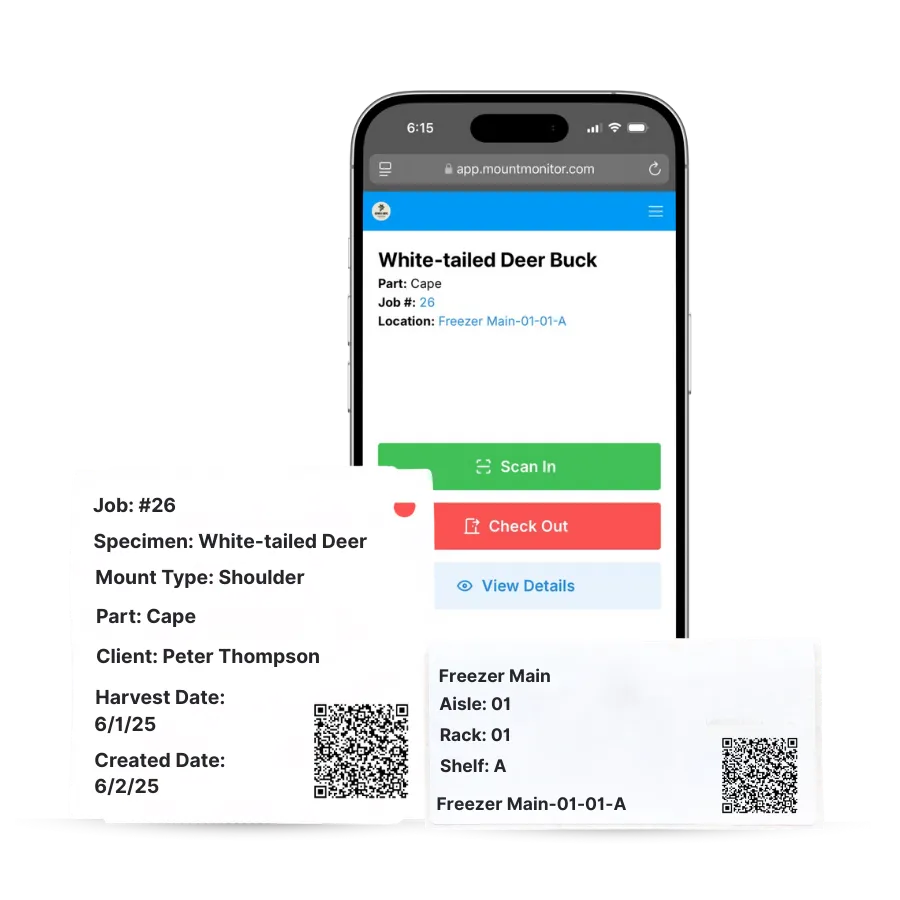
Tags print in seconds, making it practical to label work as it comes through intake. When a batch needs to move, continuous scanning helps staff process tagged items one after another instead of stopping to search for each record manually.
At tannery volume, the cost of every physical tag matters. MountMonitor's printed labels cost roughly $0.18 each. They provide a durable QR connection without requiring a more expensive cattle-style tag for every hide. That is the approximate label consumable cost, excluding the printer, shipping, and tax.
The QR code connects the physical hide to its digital record. Your team no longer has to guess which handwritten number belongs to which spreadsheet row.
A stage explains what is happening to a job. A location explains where the physical item is. MountMonitor can track both.
Create locations and sub-locations around your tannery: receiving, storage areas, production areas, drying racks, quality control, dispatch, or any structure that matches the facility.
Scanning an item into a location can also advance its job to the connected stage. One scan can update the location, move the workflow forward, and send the appropriate client update.
That connection matters when a tannery has many similar hides moving through the same building. Staff can look up an item before walking the floor, while managers get a clearer view of the work currently sitting in each area.
The operational side of tanning cannot be separated from billing. MountMonitor keeps invoices, balances, and payments attached to the client and job.
Your team can see whether a deposit has been collected, what remains outstanding, and whether the account is ready for pickup or shipping. Clients can receive invoices and pay online through the same connected experience.
For a tannery working with repeat taxidermy studios, the client history also provides useful context across jobs instead of treating every hide as an isolated transaction.
Basic tannery tracking can become another narrow tool that tells you a status but leaves everything else scattered. MountMonitor brings together:
The result is one operational record from intake through production, billing, and return.
Taxidermists use MountMonitor to track capes and hides sent out for tanning and returned to the studio. Tanneries can use the same core system to manage the work happening inside their own operation.
That shared workflow is useful because the underlying problem is the same: physical items must remain correctly identified while the business keeps the client informed and the financial record current.
Whether your customer is a large taxidermy studio or an individual sending a single hide, the system should make it easy to answer three questions immediately:
Tannery software helps a tannery manage clients, jobs, hides, production stages, locations, communication, invoices, and payments. The most useful system connects the physical item to its digital record throughout the workflow.
Yes. MountMonitor can be configured around a tannery's clients, stages, and physical locations. It is not limited to taxidermy studios mounting finished specimens.
Yes. A tannery can choose which job stages trigger automatic email or SMS updates. Internal stages do not have to send a message.
MountMonitor's taxidermy-proof tags are designed to remain readable through freezer, tanning, and general shop conditions.
Yes. A client record can represent a taxidermy studio, taxidermist, or individual customer, with their jobs, communication, invoices, and payments kept together.
If you run a tannery and want to replace paper tags, disconnected spreadsheets, and manual customer updates, we can map MountMonitor around your current workflow.
Start your free month or contact MountMonitor to see how the system can work from intake to finished hide.